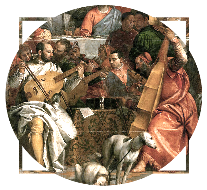


Welcome to theweddingatcana.org, an academic initiative devoted to sharing and spread, both among the scientific community and general public, the results of research resulting from several years of academic studies.
Our multidisciplinary research team is dedicated to documenting the findings revealed by X-rays carried out in the 1990s on the monumental canvas The Wedding at Cana by Paolo Caliari, Veronese.
These investigations arise from our original proposal about the identity of one of the participating musicians as the Neapolitan chapel master Diego Ortiz.
- You can visit our Portfolio where you will find a classification of the various research projects published by category.
- The findings obtained have also been disseminated in conferences and master classes held at higher education institutions (higher conservatories, congresses ... ) recorded (mainly in Spanish) and can be viewed from this website, new playlist and its Youtube Channel.
The detailed study of the compositional and underlying elements (X-rays) of the canvas, has allowed us to elaborate a scientific and solid proposal of the various changes that the Veronese made until the last moments of his delivery.
The papers, books, and multimedia materials that we present here include these findings as well as a coherent narrative of them. These works have been presented in various scientific publications and, due to the multiple branches that derive from them, our team has also opted for digital publication under the Creative-Commons license in order to facilitate their dissemination to the scientific community and interested public.

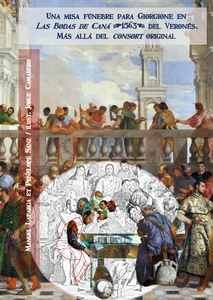
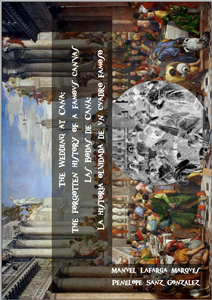
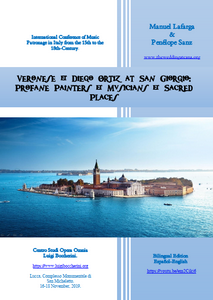

As we have mentioned before, this scientific work began in 2016 documenting the presence of Diego Ortiz and Giorgione in the great canvas of Veronese, but at that time nothing made us suspect the marvelous work that awaited us after this discovery and that is why we want to invite, from here, everyone to take part of this research.
Publications
- The successive changes that occurred in the central musical scene (Consort 1 - 5) of the painting, according to our model, can be more fully understood in the publication The Five Consort of Veronese's The Wedding at Cana, 1563. This small book (bilingual: English-Spanish) is offered to the reader as a quick reference guide.
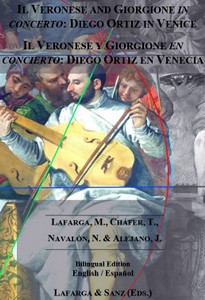
- Il Veronese and Giorgione in concerto: Diego Ortiz in Venice. We are proposing that the Spanish musician Diego Ortiz is represented in Paolo Veronese’s famous mannerist picture "The Wedding at Cana". Specifically, we suggest that he is the person who seems to be making comments to Veronese, as the conductor of a viola da gamba ensemble.
- The wedding at Cana: the forgotten history of a famous canvas. [Download PDF]. How Paolo Caliari buried the great master Giorgione for a second time under the colors of his palette, and the swings of the protagonists of the monumental work that marveled Europe for centuries.
- Veronese and Diego Ortiz at San Giorgio: Profane Painters and Musicians and Sacred Places. [Download PDF]. Bilingual Edition: Spanish-English. International Conference of Music Patronage in Italy from the 15th to the 18th-Century. Centro Studi Opera Omnia Luigi Boccherini. Lucca, Complesso Monumentale di San Micheletto. 16-18 November, 2019. https://www.luigiboccherini.org/
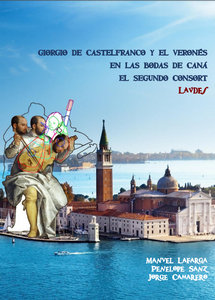
- The Second Consort: Lutes. Veronese's gigantic canvas for the congregation of San Giorgio Maggiore proved to be, during the fifteen months it took to complete, a rather eventful undertaking on a busy scaffold: it had been commissioned by the Venetian monks a few months after the start of the last session of the Council of Trent, and was delivered two months before its completion.
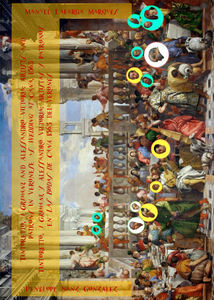
- Tintoretto, i Grimani, and Alessandro Vittoria: Artists and patrons in Veronese ‘s Wedding at Cana. Alessandro Vittoria portrayed a large number of relevant contemporary characters in stone there in Venice, and at the same time, he was also portrayed by distinguished artists and friends. One of them, Paolo Caliari, included him in his formidable Wedding at Cana (1563) canvas, along with tens of Venetian and international authorities, renowned local Venetian artists, as well as ecclesiastical authorities and influential people associated to the Benedictine Order. For several decades, Alessandro was a regular collaborator to the author of the canvas and some of those depicted in there: We think that he could be the fifth commensal placed to the left of Jesus Christ.
Paolo Caliari Veronese: Minerva, Geometry and Arithmetic, 1551.